
Browse 14,093 OTUs, compare ecological and phylogenetic neighbours, and view predicted traits
DysbiosisScore
Score a faecal 16S rRNA sample against a reference cohort of 10,276 samples
DataDownload
Sample-level metadata for the 13-disease reference cohort
Social niche embeddings of the human gut microbiome
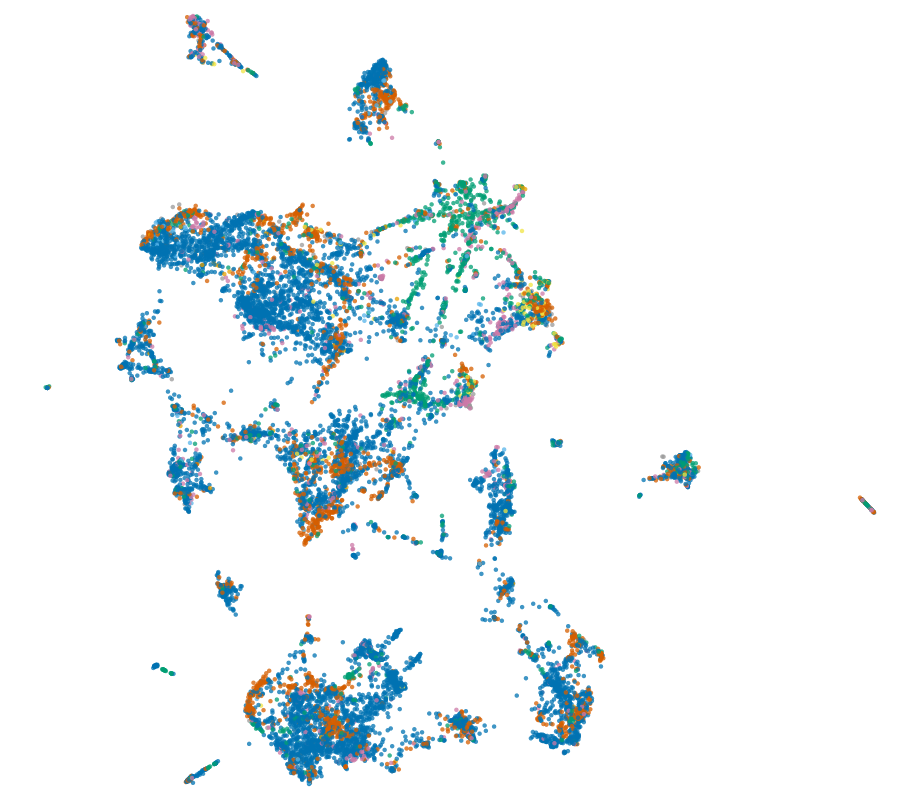
We represent each of 14,093 SILVA 138.2 OTUs (97% identity) as a 100-dimensional social niche embedding, learned from co-occurrence patterns in approximately 210,000 human faecal samples. Two OTUs lie close together when they share co-occurrence partners, that is when they keep the same company, rather than when they occur together, and keeping the same company is what it means to occupy a similar social niche, independent of phylogenetic relatedness. This site provides an interactive atlas of the embeddings, trait predictions for uncultured taxa, a research-use dysbiosis score and downloadable data files.
Scope and limitations
The embeddings describe realized niches: the ecological role of a taxon within the gut community, inferred from the taxa it co-occurs with. This is not equivalent to its physiology in pure culture. For example, an OTU predicted to be anaerobic is one whose gut neighbours are anaerobes. That is evidence about the niche it occupies, not a measurement of its oxygen tolerance in culture.
All models were trained on human faecal 16S rRNA data. The results do not apply to soil, marine, oral or skin communities, and none of the outputs are intended for diagnosis.
How to cite
Ecological embeddings reveal microbial social niches that generalize across diseases. Manuscript in submission.
BibTeX and version information are available on the citation page.